In this guide
Children often cannot explain exactly where a shoe feels tight, rubs, or fails to hold the heel. That is why choosing a new pair means looking beyond the size on the box and checking the actual fit: foot length and width, room in front of the toes, support, and how the shoes behave while walking.
Below is a clear step-by-step guide to choosing children’s shoes in a store or online while reducing the risk of selecting the wrong size.
Why size alone is not enough
Sizing charts vary between manufacturers. Two children with the same foot length may also have different foot widths, instep heights, and toe shapes. Even two styles in the same size can feel different because of the last, upper material, and lining thickness.
Consider these three things together:
- the length of both of the child’s feet;
- the size chart for the specific style;
- how the shoes fit while the child is moving.
The number on the sole is a starting point, not the final answer.
How to measure a child’s foot at home
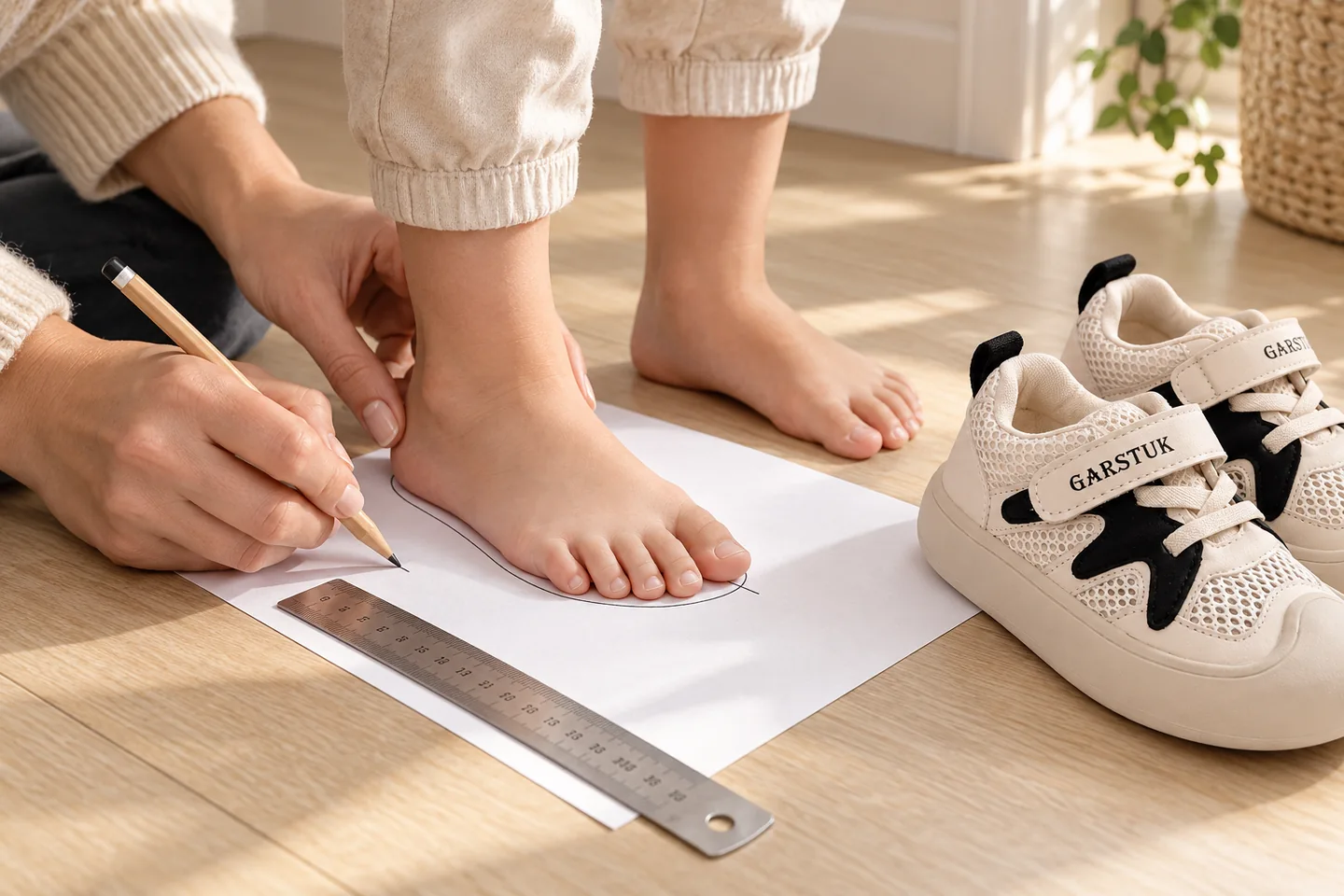
It is best to measure in the afternoon, because feet may be slightly larger after normal activity than they are in the morning. The child should stand with their weight evenly distributed on both feet. For winter or mid-season shoes, use socks of the same thickness the child will normally wear with the shoes.
Step-by-step instructions
- Place a sheet of paper on a hard, level floor next to a wall.
- Have the child stand on the paper with the heel lightly touching the wall.
- Make sure the child is standing upright and not curling their toes.
- Mark the point in front of the longest toe.
- Measure the distance from the edge of the paper to the mark in millimetres.
- Repeat the measurement for the other foot.
If the measurements differ, choose the size based on the larger foot. Write down the result and compare it with the size chart for the style you plan to buy.
Helpful tip: tracing around the foot is possible, but a vertical mark in front of the longest toe is usually more accurate. Holding the pencil at an angle can add extra millimetres.
How much growing room should children’s shoes have?
Some extra room lets the toes move freely during each step and prevents the child from outgrowing the shoes immediately. However, “the more, the better” does not apply: shoes that are too long may hold the foot poorly, interfere with a natural stride, and increase the risk of tripping.
The appropriate amount of room depends on the type and construction of the shoe and the manufacturer’s guidance. When shopping online, always check the size chart for the specific style. After trying the shoes on, assess not only the room in front of the toes but also the heel position, width, and walking comfort.
7 signs of a good fit
1. The toes do not touch the front and can move
Ask the child to wiggle their toes. The toe box should not squeeze them from the sides or above. If the outline of the toes is clearly visible through the material, the style is probably too narrow or too small.
2. The heel stays secure
The heel should not slip noticeably while walking. The UK NHS also recommends checking support: laces, a buckle, or a hook-and-loop strap help hold the heel and stop the foot sliding forward. If the heel comes out when the child rises onto their toes, the pair may be too large.
3. The shoe does not squeeze the foot across its width
Check the sides. The material should not stretch tightly or bulge around the little toe or big toe. Pressure marks, redness, or complaints that the shoe feels tight are reasons to try a different width or style.
4. The fastening adjusts the fit
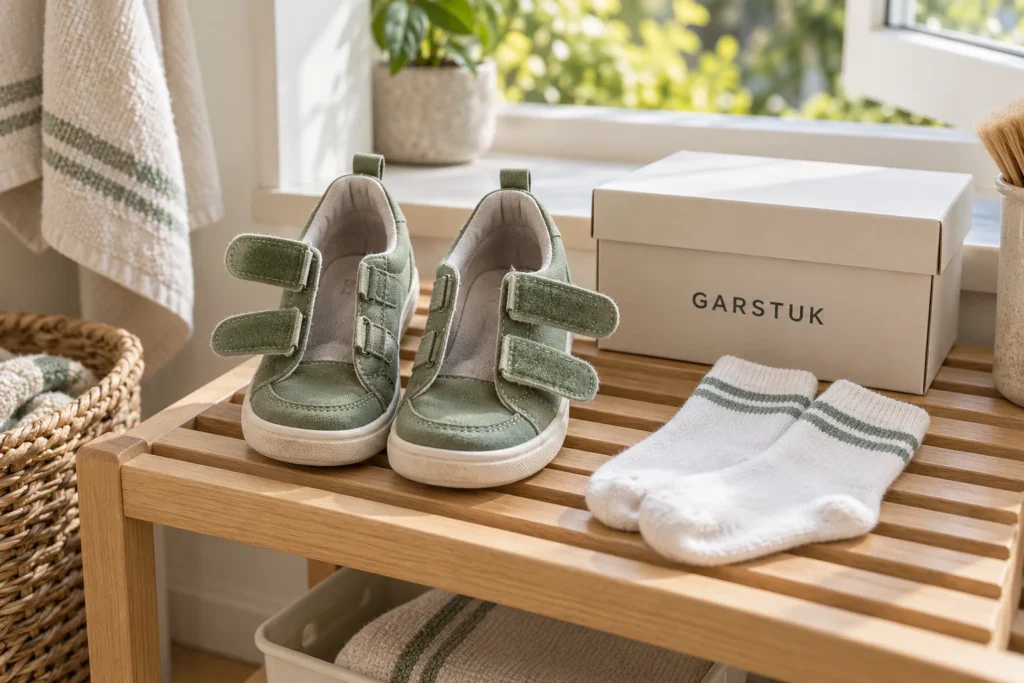
Hook-and-loop straps, laces, or buckles should secure the shoe rather than simply decorate it. Ideally, the fastening can be adjusted to suit the instep. For children learning to put on their own shoes, a hook-and-loop strap is often easier than complicated lacing.
5. The sole bends where the foot bends
While walking, the sole should allow the foot to roll naturally. Watch the child walk, squat, and rise onto their toes. The shoes should not look heavy or cause the child to shuffle.
6. There are no rough seams or folds inside
Run your hand over the inside. Make sure the lining lies flat, the insole does not bunch up, and no seams or edges press against the skin. The sock should not form folds inside the shoe either.
7. The child walks naturally
Ask the child to walk for several minutes, turn, squat, and run a little if space allows. Warning signs include a changed gait, frequent stops, attempts to remove the shoes, tripping, or complaints of pressure.
How to check the size when shopping online
An online order is easier if you prepare four measurements before buying:
- the length of the larger foot in millimetres;
- the approximate foot width;
- the usual type of sock;
- the insole length of a current pair that fits well.
Do not choose a size based on age alone: children grow at different rates. Open the size chart for the specific style and check whether it lists foot length or insole length. These are different measurements.
After delivery, try the shoes on at home on a clean surface. The child should try on both shoes with suitable socks and walk around for at least a few minutes. Check the skin immediately afterwards: clear red marks around the toes, sides, or heel may indicate a poor fit.
Common mistakes parents make
Buying shoes “two sizes larger”
A large amount of extra room does not guarantee savings. If the foot slides, the child has to tense their toes more, and the shoes may rub and interfere with movement.
Checking the size only by pressing the toe
This can be misleading because the child may curl their toes. It is better to measure both feet in advance and assess the entire fit while the child is standing and walking.
Trying on only one shoe
Feet often differ slightly. Try on both shoes and use the larger foot as the reference.
Choosing by appearance alone
Colour and design matter, especially to a child, but a comfortable fit, a suitable fastening, and construction appropriate for the season are more important.
Not rechecking the size after purchase
Children’s feet grow, and a child may not immediately say that their shoes have become too small. Check the toes and heels regularly, watch the child’s gait, and repeat the foot measurement.
Quick checklist before buying
- Both feet have been measured while the child is standing.
- The size is based on the larger foot and the chart for the specific style.
- The toes are not squeezed and do not touch the front.
- The heel is held securely without rubbing.
- The upper does not press across the width or instep.
- The fastening allows the fit to be adjusted.
- The child walks naturally and does not trip.
- There are no folds, raised seams, or foreign objects inside.
- The material and lining suit the season and wearing conditions.
You can find a suitable pair in the GARSTUK children’s shoe catalogue — use the filters for season, size, and purpose, and check the size chart for the specific style before ordering.
Questions and answers
Can children’s shoe size be chosen by age?
Age provides only a rough guide. It is more reliable to measure both feet in millimetres and compare the longer measurement with the size chart for the specific style.
When is the best time to measure a child’s feet?
The afternoon is convenient, after the child has been active. For seasonal footwear, measure the feet while the child is wearing socks of the appropriate thickness.
How can you tell if shoes are too large?
Possible signs include noticeable heel slippage, the foot sliding forward, shuffling, or more frequent tripping. Assess the whole fit, not only the room in front of the toes.
How can you tell if shoes have become too small?
Look for pressure marks, redness, rubbing, curled toes, complaints of discomfort, or reluctance to wear a familiar pair. Measure both feet again and compare the result with the insole and size chart.
Does a child who is not yet walking need shoes?
For a healthy child who has not yet started walking independently, shoes are generally needed mainly to protect the feet from cold and the environment. If there are medical concerns, seek advice from an appropriate healthcare professional.
Editorial note: This article is for general information and does not replace advice from a paediatrician, orthopaedic specialist, or podiatrist. Seek professional advice if the child has pain, a pronounced asymmetry in gait, persistent rubbing, or other concerning symptoms.
Source for general fitting guidance: NHS — Leg and foot problems in children.