In this guide
An older child’s shoes can look almost new, and a resale listing may say “worn twice”. Neither a photograph nor a familiar size number shows how the pair will fit a different foot. When considering previously worn children’s shoes, start with reasons to reject a pair rather than ways to justify a tempting price.
What the guidance says
Oxford Health NHS advises trying to avoid buying second-hand children’s shoes. The APMA parent leaflet also advises against handing down worn footwear: the same shoe can fit children differently, and sharing footwear can spread fungal infections.
For regular outdoor use, looking for a suitable new pair is the more cautious choice. A home inspection can reveal obvious problems, but cannot certify safety or rule out infection. Shoes that have never been worn are a different situation from an actively used pair; the fit still needs to be checked afresh.
Start with the history, not the photograph
For a pair already in the family, establish who wore it, for how long, whether it was soaked or repaired, and how it was stored. If its history is unknown, do not fill the gaps by assuming the inside is clean. “Washed before sale” describes an action, rather than proving suitability.
For an online purchase, ask for clear pictures of both soles, the heels and the inside. A refusal to show these areas is a reasonable reason to walk away. Even good photographs cannot replace inspecting the shoes in person and checking them on the child.
The size label is only a starting point
Compare the pair with current measurements of both of the child’s feet, rather than a sibling’s shoe size. Check width, instep space and heel hold. A previous owner’s preference for one brand does not establish that its model will suit another child.
A tight shoe is not made suitable by a promise that it will stretch. If closures must be tightened to their limit to keep the shoes on, compare a different size or shape. Our size and fit guide explains a fitting without choosing by age alone.
Inspect both soles and the shape of the pair
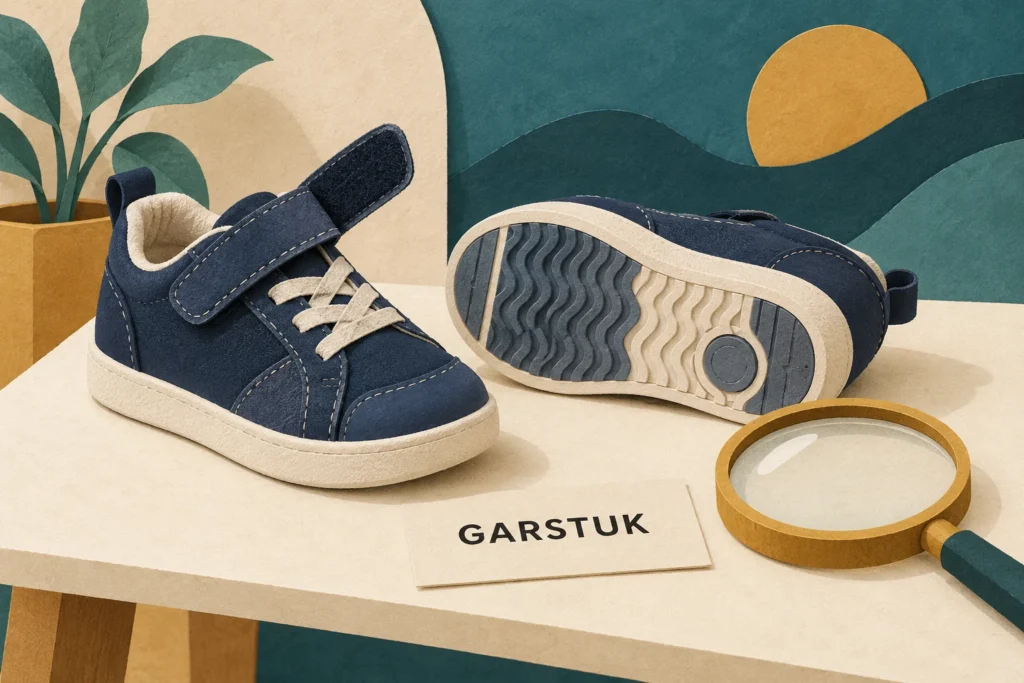
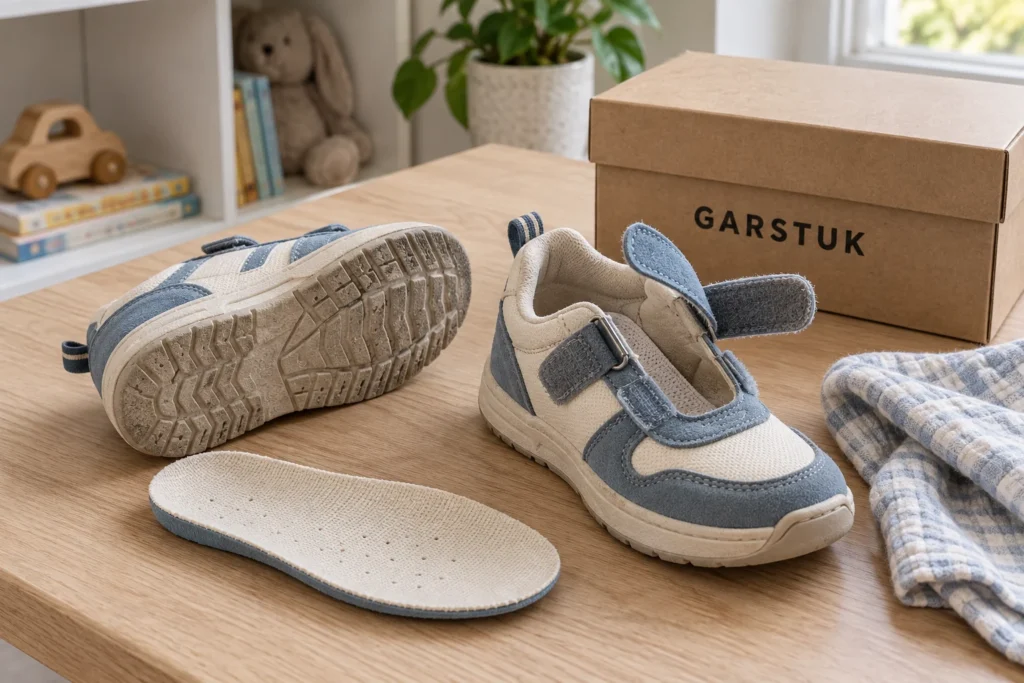
- Place both shoes on a level surface and compare the position of the heels.
- Look for an obvious lean, substantial uneven wear or areas where the tread has worn away.
- Check for cracks, sole separation and damaged stitching.
- Check that straps, laces and closures actually hold the shoes securely.
Substantial wear is a reason to reject a pair for further everyday use. A wear pattern does not let you diagnose a condition at home. If you are concerned about the child’s walking, or their own shoes repeatedly develop a pronounced lean, discuss this with a clinician.
Check the inside and consider hygiene
Inspect the lining, seams and heel area: rough damage and hard folds can interfere with comfort. If an insole is designed to be removable, take it out gently and check for distortion or remaining dampness. Do not tear out fixed parts.
Cleaning cannot rebuild a worn shoe, and a replacement insole cannot correct an unsuitable shape. Smell is not a reliable infection test: the absence of odour offers no such guarantee. If the previous wearer had a known fungal infection, do not pass the shoes to another child; ask a medical professional about treatment and hygiene.
When to reject a pair straight away
Do not use shoes that press on the foot, slip off, lean noticeably, have damaged soles or have a rough lining. Cosmetic cleaning or an arbitrary insole should not be expected to solve these problems. Individually prescribed footwear should not be handed down as a universal everyday pair.
To manage a budget, compare new models against the actual fit and intended use instead of accumulating unsuitable shoes. Care can help a child use their own pair while its condition and fit remain suitable, but cannot remove the need for replacement.
Common questions
Can good-looking shoes be passed to a younger sibling?
A tidy appearance does not establish fit or hygiene. Medical guidance advises avoiding hand-me-down footwear, particularly for regular use.
Does a new insole make a used pair suitable?
No. It does not correct a lean, worn soles or an unsuitable width and instep fit. A replacement may also reduce the space inside.
What if the shoes were bought but never worn?
That differs from passing on a worn pair. Check storage conditions, the state of every part and the current fit on the child; the purchase history does not replace a fitting.
Your next step
To compare a new pair, prepare measurements of both feet and describe its intended use. You can ask the GARSTUK team about a model on WhatsApp. For a child’s own shoes, our cleaning, drying and storage guide is a useful companion.
Sources
- Oxford Health NHS: children’s foot care and shoe fitting.
- APMA: children’s foot health and shoe-shopping leaflet (PDF).
Sources checked on 7 October 2026. Home inspection does not replace medical assessment for pain, skin problems or changes in walking.