In this guide
A description saying “leather” does not tell you what is inside a shoe or what its sole is made from. Start a useful comparison by identifying the part each statement refers to. Then check intended use and care separately. This reading order makes enquiries more precise and avoids turning a familiar symbol into an unsupported conclusion.
Organise the information into three parts
The EU footwear labelling system describes materials for the upper, lining and insole, and outer sole. Information can use pictograms or words. This is a useful example for reading a label; requirements and labelling formats depend on the market where the footwear is sold.
Start a simple note: “upper — …; interior — …; outsole — …”. If a part is not explained, leave it as a question. Do not apply an upper-material description to the entire shoe. Look for information about each part in the listing for the exact style.
Read the part and material together
With pictograms, first identify the shoe component and then the material beside it. Your Europe lists leather, coated leather, textile and other materials for this system. The last category alone cannot identify the exact composition of a particular sole or upper.
Take a clear photograph of the complete label rather than one isolated symbol. If its meaning is unclear, ask the seller to explain the entire row in words and identify the source of the style information. Surface texture in a photograph helps you inspect appearance, but cannot establish composition.
Understand the scope of a material statement
The EUR-Lex explanation links the EU main-material indication to an 80% threshold: surface area for the upper and lining with insole, and volume for the outsole. If no material reaches the threshold, the two main materials are indicated. A main-material statement therefore does not establish that the whole component contains only that material.
For an everyday comparison, keep the seller’s complete wording rather than converting a symbol into an “entirely one material” promise. If exact composition or information about an individual detail matters, ask a separate question using the style code.
Ask about performance separately
Composition cannot answer every use question. Rain requires information on permitted conditions, winter requires details of the particular construction, and indoor sport requires the sole’s intended use and venue requirements. A material indication is not a measurement of water resistance, warmth or grip.
Ask which model information or instructions support a stated property. Do not infer a membrane from a fabric photograph or treat outsole colour as confirmation of its performance. Our materials and weather guide explains useful questions to ask.
Find the care instructions
Composition provides a starting point for discussing care, but the cleaning method should suit the complete model. Footwear can combine several surfaces and components. Before applying a product, establish that it is suitable for that style and check its application instructions.
A washable textile by itself does not establish that the assembled shoe can be washed. Check permitted drying methods, heat restrictions and whether any specific products are recommended. Save the instructions or link with the style code. Our care guide covers general inspection and storage steps.
Compare models using the same questions
For each pair, record the materials of the three parts, intended use, supported performance information and care instructions. Add your practical context: where the child will wear the shoes and how much maintenance time is realistic. Mark missing information as an enquiry rather than filling the gap with a guess.
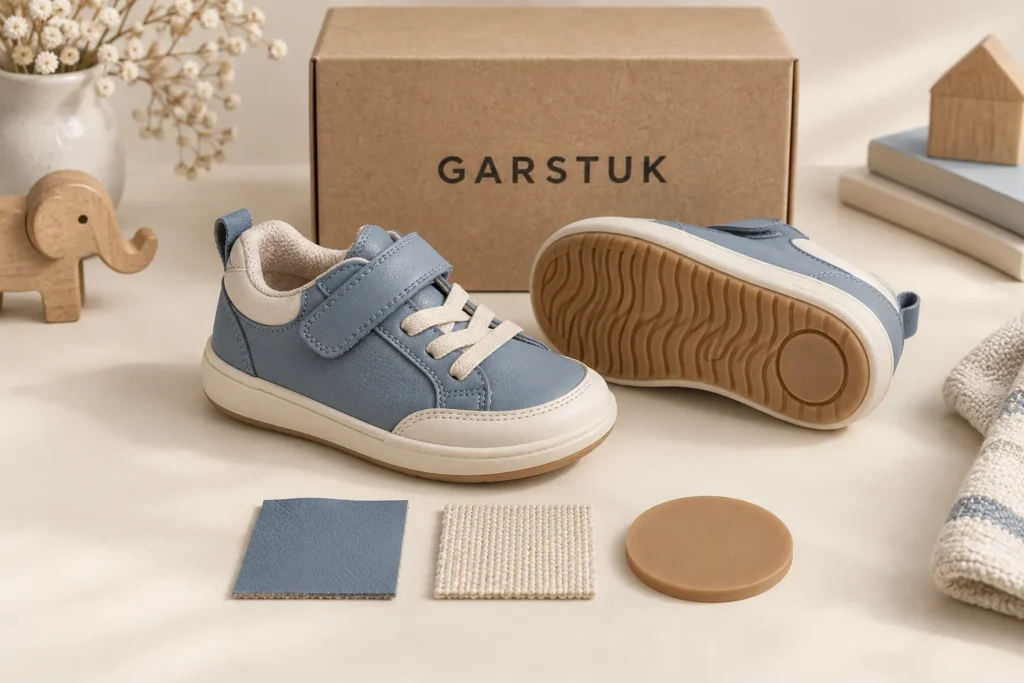
For example, two pairs with the same upper-material indication may have different linings and cleaning instructions. Comparing only the first row hides that difference. An editorial photograph with loose material samples also cannot prove the composition of a marketed shoe style.
Complete the comparison with a fitting
Even a detailed label cannot show fit on an individual child’s feet. Check both shoes with the usual socks and properly adjusted fastenings. Consider length, width, instep space and the child’s comfort; compare a different shape when necessary.
For a remote purchase, request information for the exact style beforehand and clarify how to assess the delivered pair. Our size guide helps with preparation. Material-description terminology cannot replace a professional’s instructions when footwear has been prescribed.
Common questions
Does a leather indication refer to the whole shoe?
Check the component it accompanies. Read upper, interior and outsole information separately.
Does a textile lining mean that the shoe can be washed?
Check the instructions for the complete style, including its other materials and assembly.
Can an unfamiliar symbol establish the quality of a pair?
Obtain its meaning first. Composition, construction quality, intended use and fit require different information.
How to ask GARSTUK about a label
Send the style code, a clear photograph of the label and a question about the specific component: upper, lining or outsole. Add the intended use and any care question that affects your choice. Contact the GARSTUK team on WhatsApp to clarify model information.
Sources
Sources checked on 11 October 2026. Use the actual pair’s label and current manufacturer or seller information when assessing a particular style.