In this guide
Changing an insole can make a familiar pair feel different: the foot sits higher, space above the toes changes and the heel may be held differently. A size number alone cannot choose a replacement. This guide explains inspection and a repeat fitting, and separates ordinary shoe care from a medical prescription.
Identify the type of insole first
An ordinary shoe inlay forms part of the footwear’s construction. A replacement can differ in thickness, shape and material. A prescribed orthosis has a separate purpose and its own instructions; advertising terms such as “anatomical” or “orthopaedic” do not establish that purpose.
If a child has a prescription, do not substitute an arbitrary shop-bought insert or pass their device to another child. Discuss footwear, changes to the construction and the wearing routine with the prescribing clinician.
Check whether removal is intended
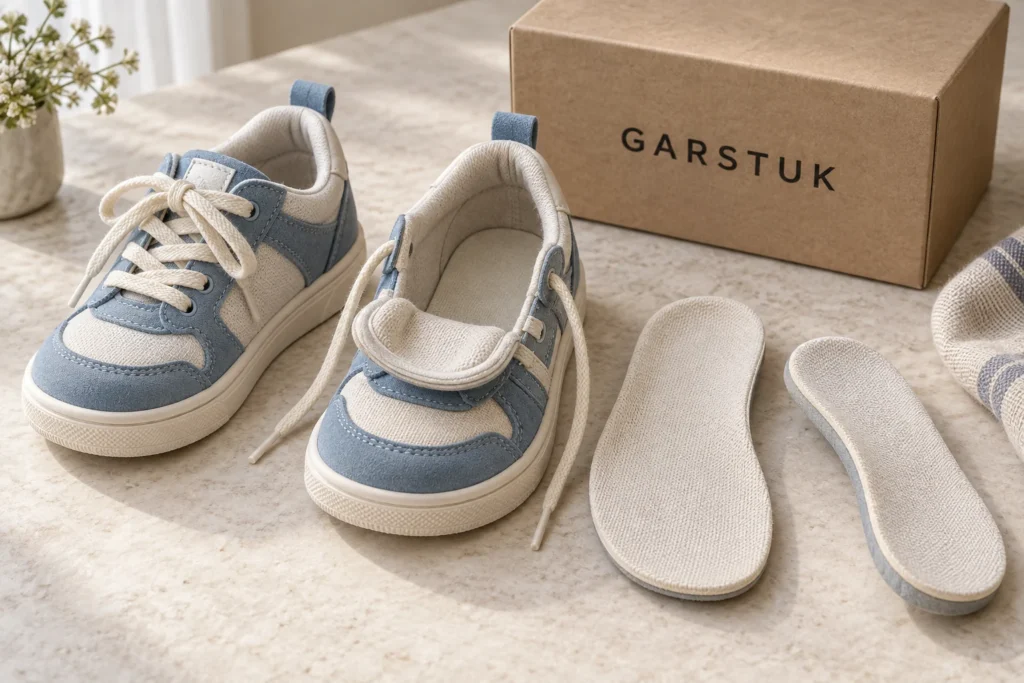
Read the model’s instructions and gently check the edge of the inlay. A part that comes out easily can be inspected separately. Do not tear out a glued component, dismantle the lining or cut the shoe to create space. Ask the manufacturer or seller first if you are unsure.
Photograph the original arrangement. When one set of prescribed orthoses is used in several suitable pairs, it helps to keep a note of which original insole belongs to each shoe.
A replacement changes the available space
A thicker insert occupies some of the shoe’s internal volume. Check space above the toes, pressure over the instep and depth around the heel, as well as toe length. The size printed on the box does not guarantee the same fit with different insoles.
Oxford University Hospitals guidance explains that removing an original inlay can create space for an orthosis, and that a different shoe style may sometimes be needed. This is not a universal instruction to remove every insole: follow the particular device’s instructions, especially where a clinician has specified how the parts should be arranged.
Inspect condition and shape
- Look for turned-up edges or firm folds.
- Compare the two insoles for a loss of their original shape.
- Check damaged coverings, remaining dampness and the area under a removable inlay.
- Make sure the part lies flat and does not move around inside the shoe.
Ask about a suitable replacement for a damaged ordinary insole. Take a damaged prescribed orthosis back to the clinician. Do not choose a medical-device replacement from a photograph alone or trim it yourself.
Fit both shoes again
After fitting a permitted replacement, use the child’s normal socks, put on both shoes and adjust the closures. Ask the child to walk a little on a safe surface. Check for heel slipping, pressure from the upper and a need to tighten straps or laces excessively.
Dorset HealthCare advises bringing prescribed insoles or orthoses when buying shoes and checking sufficient depth. Do not assume that a combination that worked in one model will fit another. Our size guide explains measuring both feet.
Do not correct sizing with arbitrary layers
Extra inserts can change the position of the foot, but cannot turn an unsuitable shoe shape into a suitable one. Do not disguise an oversized pair with random layers, or remove a necessary component to continue wearing a tight shoe. Repeat the size check and compare another model instead.
If prescribed insoles are uncomfortable, discuss the shoe-and-device combination with the clinician. Do not respond to pain by buying increasingly thick or rigid inserts.
Care without a universal formula
An ordinary insole and an orthosis may have different care requirements. Check permitted cleaning and drying methods; a textile covering does not automatically mean machine washing is allowed. Do not put a damp removable part back into a shoe for long-term storage.
Note when an inlay was changed and how the child’s comfort changed. Persistent rubbing, pain or altered walking needs professional advice instead of repeated home experiments. Check sock thickness and folds separately so that different sources of discomfort are not confused.
Common questions
Does every healthy child need an “orthopaedic” insole?
An advertising label cannot establish a universal need. A clinician determines whether a medical device is necessary and which one is appropriate.
Should the original insole always be removed for an orthosis?
The arrangement depends on the device, shoe and prescription. Check the instructions and ask the clinician; do not stack parts arbitrarily.
Can a tight shoe be made suitable by removing its insole?
Removal may change the fit, but cannot correct inadequate length or an unsuitable shape. It should not replace a fresh size check.
What to ask before ordering
Ask whether the actual model has a removable inlay and whether information about internal depth and suitable replacements is available. You can discuss construction with GARSTUK on WhatsApp. Compatibility with a medical device is checked at the fitting and with the prescribing clinician.
Sources
- Oxford University Hospitals NHS: shoes for orthoses and internal space.
- Dorset HealthCare NHS: children’s footwear and fitting with prescribed devices.
Sources checked on 9 October 2026. This guide helps prepare a fitting and does not replace an individual medical prescription.