In this guide
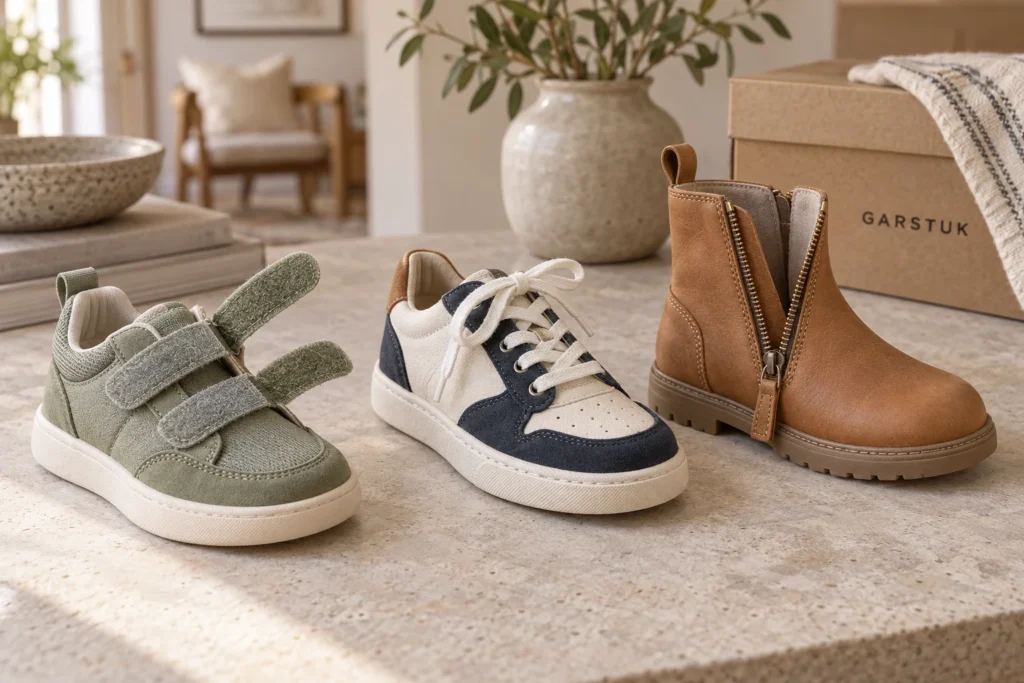
Two pairs in the same size can feel different because of their fastening. One lets you adjust the upper around the instep; another simply makes the shoe easier to put on. When choosing children’s shoes, check how the fastening holds the foot as well as how quickly it closes.
This GARSTUK guide explains what to check with hook-and-loop straps, laces and zips during an ordinary fitting. Use it alongside our guide to size and fit.
What a fastening should do
A fastening helps keep the shoe in place. NHS guidance recommends laces, buckles or hook-and-loop fastenings to hold the heel and limit the foot sliding forwards. The name of the mechanism alone does not guarantee a good result: the actual fit on both feet matters.
Start with the shoe fully open. Use the child’s usual socks, straighten the tongue, seat the heel and then fasten the upper. If the child has to force a foot inside or tread down the heel counter, check how far the shoe opens and whether its volume is suitable.
Hook-and-loop straps: check the adjustment range
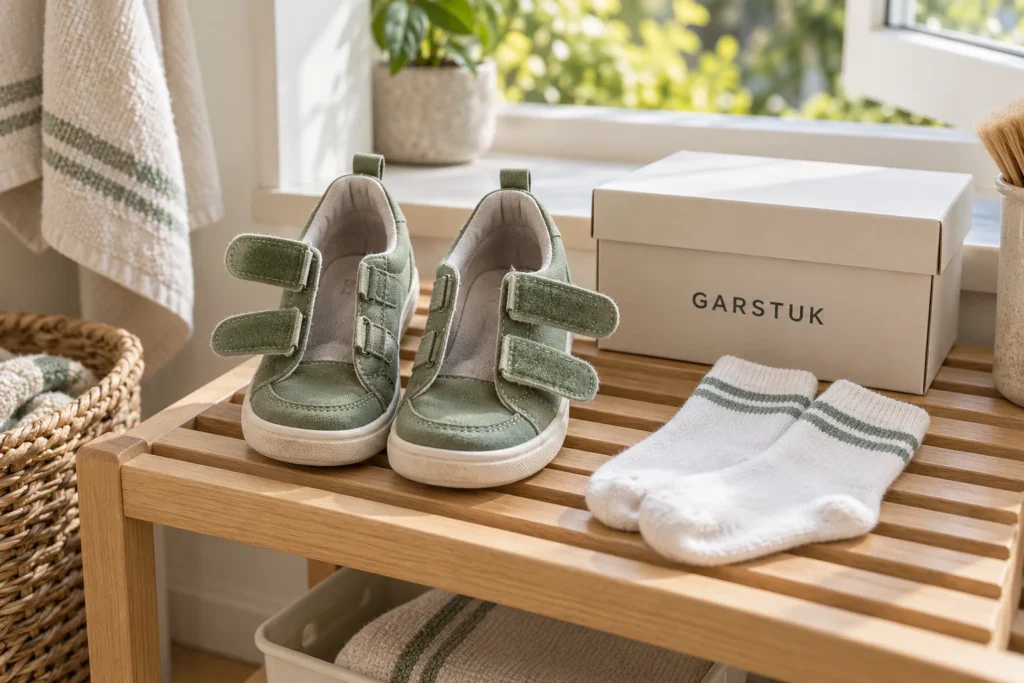
Straps can be convenient for children learning to dress themselves or changing shoes several times a day. During the fitting, ask the child to open and close each strap. Check whether it is easy to grip and return to the right position.
- The fastening surfaces should overlap securely rather than meeting only at the very edge.
- Check whether the adjustment runs out before the upper holds the foot comfortably.
- Notice whether the strap has to be stretched hard just to reach its matching surface.
- After walking, check that the straps remain closed and do not press into the instep.
If you have to use the tightest setting to hold the foot, try a different width or construction. Choosing a smaller size without checking the length again can introduce a different fit problem.
Laces: adjust the whole lacing area
Laces let you change tension at several points along the upper. Loosen them enough to put the shoe on easily, then distribute the tension from the lower eyelets upwards. Keep the tongue flat and avoid pulling the upper firmly into the instep.
Ask the child to tie the laces, or work out who will help during the day. Being able to change shoes independently at school may matter more than the appearance of a particular pair. Practise tying at home with the shoe off the foot, when there is no rush to leave.
Before walking, secure loose ends. If the shoe only stays on when the top eyelets are pulled extremely tight, recheck its length, width and volume rather than relying on extra tension.
Zips: easy access is different from adjustment
A side zip often makes a boot easier to put on, but usually offers little adjustment of its volume. If a boot has both laces and a zip, use the laces to set the fit and the zip to open it, where this matches the model’s instructions.
Open and close the zip several times during the fitting. Check that the lining, tongue or sock edge does not catch. Closing it should not require you to pull the upper together forcefully. Feel for an uncomfortable fold in the internal zip guard around the ankle.
A zip does not establish that a boot is waterproof. Check the description of the specific product for that property.
Check both feet while moving
- Put on both shoes with the socks the child will actually wear.
- Seat the heels, straighten the tongues and fasten without excessive force.
- Ask the child to walk on a safe, level surface, stop and turn.
- Ask about the toes, instep and heels separately: “Where does it press? Where does it slip?”
- Remove the shoes and look for displaced socks or possible pressure points.
If a heel slips noticeably, the upper presses or the child changes their step, stop the fitting and investigate. Persistent pain or concerns about walking should be discussed with a healthcare professional.
Common questions
Are straps always better than laces?
There is no universal winner. Choose a fastening that holds this particular pair comfortably and suits the child’s skills and daily shoe changes.
Can tighter fastenings make a pair bought to grow into fit?
A fastening cannot correct unsuitable length or shape. Check growth room together with a stable fit; a tightly closed upper is not enough evidence.
What if an older strap no longer holds?
Inspect it for trapped debris and wear. Clean it only as the manufacturer permits. If it still will not fasten reliably, ask about repair or replace the pair.
What to ask before buying
Tell the adviser who will fasten the shoes, how often the child changes them and where the current pair feels uncomfortable. Our guide to wide feet and high insteps can help with volume questions. Browse the GARSTUK collection and confirm the fastening and properties of the model you select.
Sources
Health guidance on secure fastenings: NHS — Leg and foot problems in children. Dressing practice: Somerset NHS — Dressing skills: socks and shoes. Sources checked on 5 October 2026. These references do not certify medical properties of GARSTUK products.