In this guide
Wide feet or a high instep do not mean that a child needs shoes several sizes larger. The main goal is to choose a model that matches the foot length, provides enough width, and adjusts comfortably over the instep.
A proper fit helps a child move freely and prevents parents from compensating for an unsuitable shape with excessive extra space. Below is a practical checking sequence.
How width differs from instep height
Width describes the volume of the forefoot and midfoot. A high instep means that the upper part of the foot needs more internal space. These features may occur separately or together.
This is why insole length alone is not enough. Footwear may fit in length but press at the sides or over the top. Conversely, an overly long pair can feel roomier but fail to hold the heel and interfere with walking.
Measure both feet
Measure in the evening, when the foot may be slightly larger. The child should stand with weight distributed evenly. Measure the length of both feet and use the larger one as the reference.
To assess width, mark the widest part of the forefoot. Compare the result with the chart for the specific model if the manufacturer provides width as well as length.
Look for a suitable toe-box shape
The toes should rest naturally and be able to move slightly. A sharply tapered toe box may press the outer toes even when the overall length is sufficient.
A wide toe box should not mean loose footwear without support. The heel and midfoot should remain secure while the toes retain comfortable space.
Choose an adjustable fastening
Sufficiently long hook-and-loop straps, laces, and combined fastenings allow more accurate volume adjustment. For a high instep, the tongue should open widely so the footwear can be put on without force.
After fastening, a strap should close securely rather than touching only at the edge. Laces should not create deep pressure lines over the instep.
Check the upper construction
Soft inserts and a well-designed lacing system can help adapt the fit, but the footwear should still retain its shape. Rigid decorative parts near the flex point or instep may create local pressure.
Inspect internal seams, tongue edges, and the lining. They should lie smoothly and should not form folds after fastening.
Do not buy several sizes larger for growth
Extra length does not solve an unsuitable width. In an overly large pair, the foot slides, the heel lifts, and the child has to work harder to keep the footwear on during each step.
The appropriate allowance depends on the season, construction, and manufacturer’s guidance. Check it together with heel hold and toe freedom rather than as a separate number.
How to perform the fitting
- Use the socks the child will wear during the season.
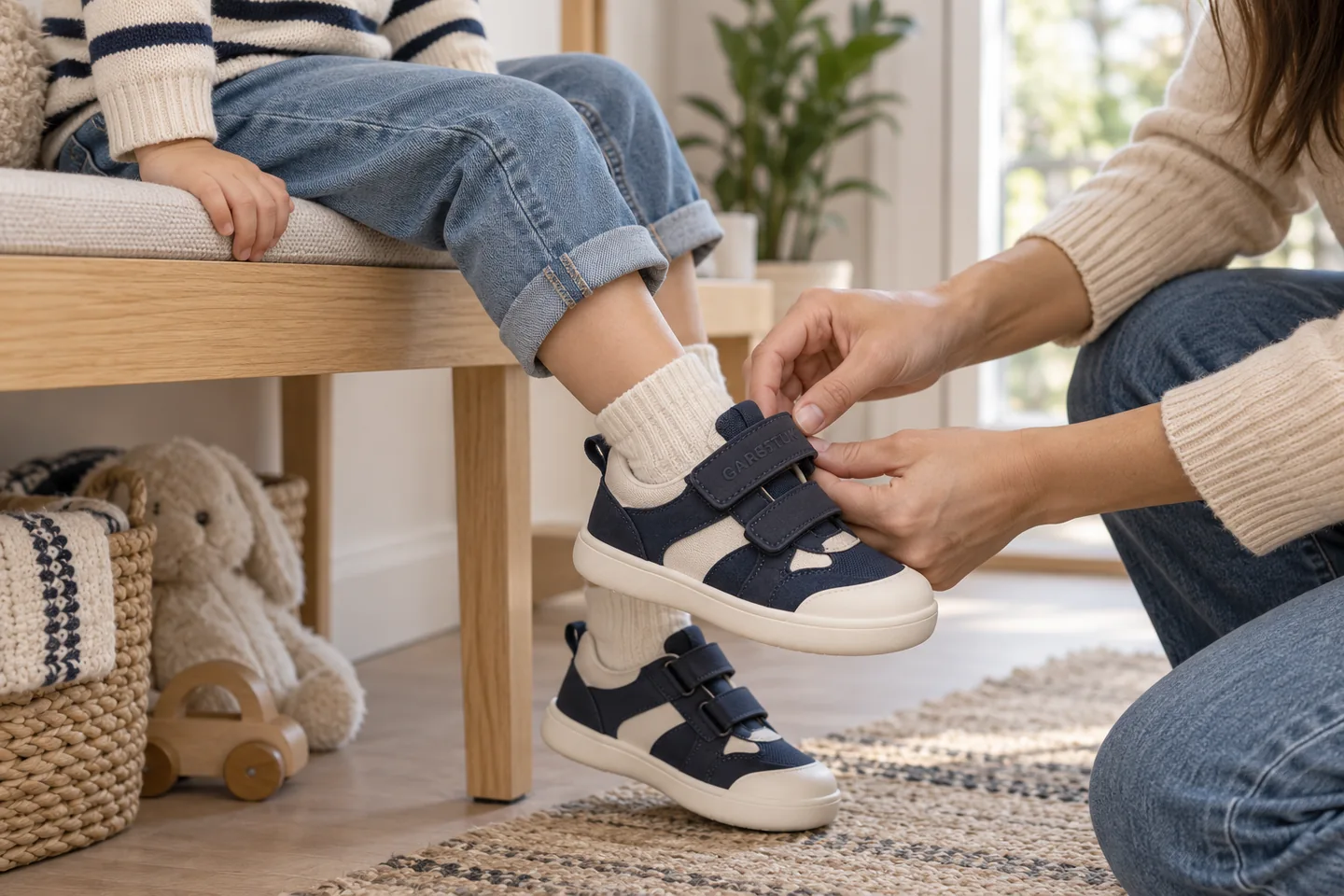
- Try on both shoes and fasten them completely.
- Ask the child to walk, turn, and squat.
- Check that the heel remains secure and the upper does not press over the instep.
- Make sure the toes are not compressed and the child’s gait does not change.
After several minutes, remove the footwear and inspect the feet. Strong red marks at the sides or over the top, repeated chafing, and complaints of pressure call for a different model or width.
Signs of an unsuitable fit
- the fastening closes only at its outer edge;
- the upper stretches or spreads noticeably;
- the heel slips while walking;
- the toes are compressed despite sufficient length;
- the child shuffles or tires quickly.
Conclusion
Wide feet and a high instep need more than simply longer footwear: the right last, a roomy toe box, and an adjustable fastening are essential. The final decision should always be confirmed by trying on both shoes while moving.
Compare styles in the GARSTUK catalogue and read our guide to signs that children’s shoes have become too small.