In this guide
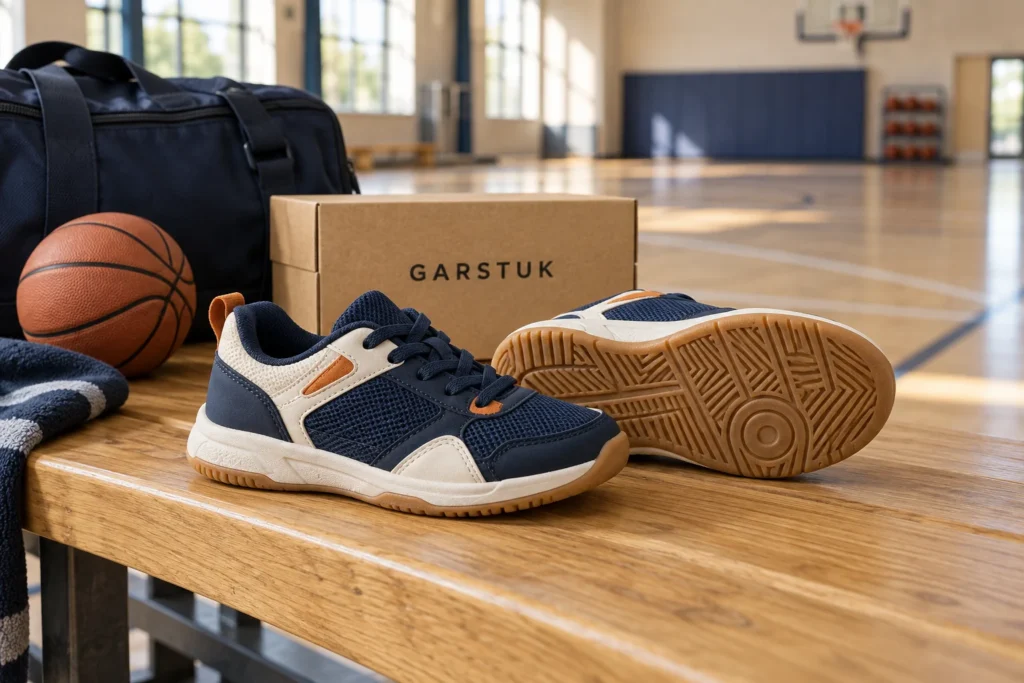
Trainers for everyday walks, running and indoor sport can look alike, but their jobs differ. Before buying shoes for physical education or a sports club, establish what the child will do and on which surface. This creates a useful brief instead of choosing a sports pair by colour alone.
Start with the activity and how often it happens
Ask about the programme: mixed school PE, running, games with repeated turns or football. Note where the sessions take place and any separate footwear requirements. For regular participation in one sport, discuss suitable specialist construction with the coach.
APMA guidance recommends choosing with the specific sport in mind. In particular, a running shoe designed for forward motion is not a universal choice for games involving substantial sideways movement. A product description saying “sports trainers” cannot answer every question about intended use.
Check the playing surface and venue rules
A gym floor, running track, dirt path, grass pitch and artificial field present different conditions. For football footwear, APMA specifically highlights matching the stud design to the surface. Do not choose a sole pattern from its photograph without information about approved use.
Ask the school or club about a clean indoor pair and non-marking soles. A light-coloured outsole does not establish a non-marking property: check the actual model’s information. Recheck the rules when changing venues rather than assuming one gym’s approval applies everywhere.
Prepare a fitting for the actual use
- Measure both feet rather than automatically copying the size of everyday shoes.
- Bring the socks the child will wear during the activity.
- For prescribed orthoses, agree footwear with the clinician and bring the devices.
- Try both shoes with the closures adjusted normally.
Thick socks and inserts alter the space inside. Check width, instep space and heel hold, as well as room in front of the toes. The GARSTUK size guide explains the basic measuring process.
Check fit with gentle movement
Let the child walk and make a few small movements permitted in the fitting area. Shoes should not slip off, press on the foot or need repeated adjustment. Do not turn a shop fitting into sharp turns, jumps on a slippery floor or movements the child is not prepared for.
A secure closure should hold the shoes without excessive tightening. Compare adjustment options in our guide to straps and laces. If comfort depends on tightening everything to its limit, compare another shape or size.
Do not judge grip from one feature
A deep tread, softness to the touch or the name of a material cannot establish grip for every surface. Start with suitability for the activity and ground, then check the condition of the sole. A sticky or dirty shoe surface is not a substitute for appropriate construction.
At home, inspect for trapped objects, damage and substantial wear. Do not promise that a new pair will prevent falls. The activity, surface and movement technique also matter.
Keep the pair ready for the next session
After activity, open the closures, check for dampness and follow the care instructions. Do not leave wet footwear in a closed bag for a long period or use a drying method the maker prohibits. Check condition and comfort again before the next session.
A growing foot can outgrow a shoe before its sole wears out; the reverse can also happen. Do not impose one replacement interval in months or distance on every child. Keep reassessing fit, condition and the club’s requirements.
Comfort is one part of safe sport
Footwear is only part of preparation. The American Academy of Pediatrics highlights age-appropriate activity, rest and correctly fitted equipment; protective gear cannot prevent every injury.
Pain, a persistent limp or repeated rubbing should not simply be dismissed as trainers that need breaking in. Stop an activity that causes pain and obtain a professional assessment. Do not select a medical insole or a diagnosis from a sole-wear pattern.
Common questions
Can one pair work for every sport?
There is no universal answer. Compare movements, surface and rules for each activity; ask the coach about requirements for regular specialist training.
Is every light-coloured sole non-marking?
No. Colour does not establish that property. You need information about the specific model and the venue’s approval.
Can a large size be bought to last the school year?
Not at the expense of holding the foot securely. Choose a suitable current fit and check again as the child grows.
What to tell the seller
Describe the activity, playing surface, school or club requirements and measurements of both feet. Ask GARSTUK about a specific model on WhatsApp. Everyday children’s footwear and specialist sports shoes should not be treated as interchangeable simply because they look similar.
Sources
- APMA: choosing shoes for different sports.
- HealthyChildren.org / AAP: reducing sports-injury risks in children.
Sources checked on 9 October 2026. This guide helps prepare a footwear choice and does not replace clinical advice or a coach’s requirements.